For thick plate welding, argon offers lower cost and good penetration at standard flow rates. Helium provides higher heat input and faster travel speeds, but costs more. Choose argon for general heavy plate and helium for very thick sections or high-speed production.
- Argon remains the default shield for thick plate work because it is cheaper and provides stable arc characteristics.
- Helium increases arc temperature and allows faster travel speeds, but it requires higher flow rates and costs more per cubic meter.
- Hybrid gas mixes can reduce cost while improving penetration for very thick sections.
- Always match gas flow to joint geometry and plate thickness to avoid porosity or incomplete fusion.
- Procurement should calculate cost based on actual cubic meter consumption, not just the cylinder price.
Why gas choice changes with plate thickness
Thick plate welding demands more heat input than thin sheet. The shield must keep nitrogen and oxygen out of the molten pool long enough for the arc to penetrate. At the same time, the gas must cover the entire weld zone as the pool moves.
Argon gas for welding remains the standard for most heavy fabrication. It is dense, which helps it stay close to the weld pool. Helium shielding gas is lighter and burns hotter. That difference matters when you are welding steel plates that are several centimeters thick.
The decision is not just about performance. It is about the total cost of the weld per meter. A cheaper gas that requires a higher flow rate can end up costing more than a pricier gas that needs less.
How argon and helium behave in the arc
Argon is a noble gas with a relatively high density. It does not ionize as easily as some lighter gases. The arc stays cool compared to helium. This makes argon stable for long welds and steady bead formation. It works well with standard TIG and MIG setups on carbon steel and stainless steel.
Helium has a lower density and a higher ionization potential. The arc carries more thermal energy into the workpiece. The weld pool is deeper and wider. The arc tends to be more energetic. This behavior helps penetrate thick sections with less time spent per pass.
The trade-off is visibility and stability. Helium arcs can be brighter and harder to see in some environments. The gas also cools the workpiece less effectively than argon. In some cases, that means more heat-affected zone distortion if the travel speed is not controlled.
Flow rates and gas consumption
Flow rate is where cost differences appear quickly. Argon typically runs at lower flow rates for thick plate. A standard TIG setup might use a moderate flow, while a MIG setup uses more. Helium requires a higher flow to compensate for its lighter nature.
The same joint geometry that uses a set amount of argon will consume more helium. The cylinder may look similar in size, but the usable cubic meters are different. Helium cylinders are usually smaller because the gas expands more at low pressure.
Procurement teams should measure actual consumption per weld hour. Record the flow rate setting and the cylinder size. Calculate the cost per cubic meter. Then multiply by the number of hours for a typical project. This gives a real number to compare against.
Penetration and travel speed
For thick plate, penetration is the primary goal. Helium gives more heat per unit of time. The arc pushes deeper into the joint. The welder can travel faster while maintaining full penetration. This reduces the number of passes required.
Argon requires more passes on very thick sections. The welder may need to stop and restart the arc more often. Each restart creates a small heat-affected zone. More restarts mean more distortion risk.
The difference is most noticeable on plate above a certain thickness. Below that, the speed gain from helium may not justify the extra gas cost. Above that, the reduced pass count can save labor time.
Cost factors for procurement
The sticker price of a cylinder is not the full cost. Helium cylinders often cost more per unit. The gas is less dense, so a full cylinder may hold fewer usable cubic meters than a larger argon cylinder of similar external size.
Flow rate increases consumption. If helium needs a higher flow to maintain the same arc protection, the cost per hour rises. The welder may also need to adjust the machine settings. That takes time to dial in.
Consider the machine setup. Some MIG machines are tuned for argon. Switching to helium may require changes to the gas nozzle or the flow control valve. These small changes can add labor time.
Best uses for each gas
The table below compares the two gases for thick plate welding.
| Option | Best for | Limitations |
|---|---|---|
| Argon | General thick plate, stainless steel, long production runs | Slower travel speed on very thick sections, more passes needed |
| Helium | Very thick plate, high-speed production, high heat input | Higher gas cost, higher flow rates, brighter arc |
| Argon-Helium mix | Balance of cost and performance, thick carbon steel | More complex gas supply, requires mixing equipment |
| Argon-CO2 mix | Cost reduction for some carbon steel jobs | More spatter, less smooth arc, not ideal for TIG |
Pick argon when the plate is thick but not extreme, and the production schedule is steady. It gives a reliable arc and predictable bead. The gas is widely available, which keeps supply risk low.
Pick helium when the plate is very thick and the schedule is tight. The higher heat input reduces pass time. The faster travel speed can offset the higher gas cost if labor is expensive.
Use a mix when you need a middle ground. A small amount of helium in an argon base can improve penetration without the full cost of pure helium. This works well for carbon steel plate where spatter is not a major concern.
Practical checks before switching gas
Before changing the gas on a production line, run a small test coupon. Match the plate thickness, joint preparation, and welding parameters. Check the weld for porosity and incomplete fusion. Look at the back side of the weld for defects.
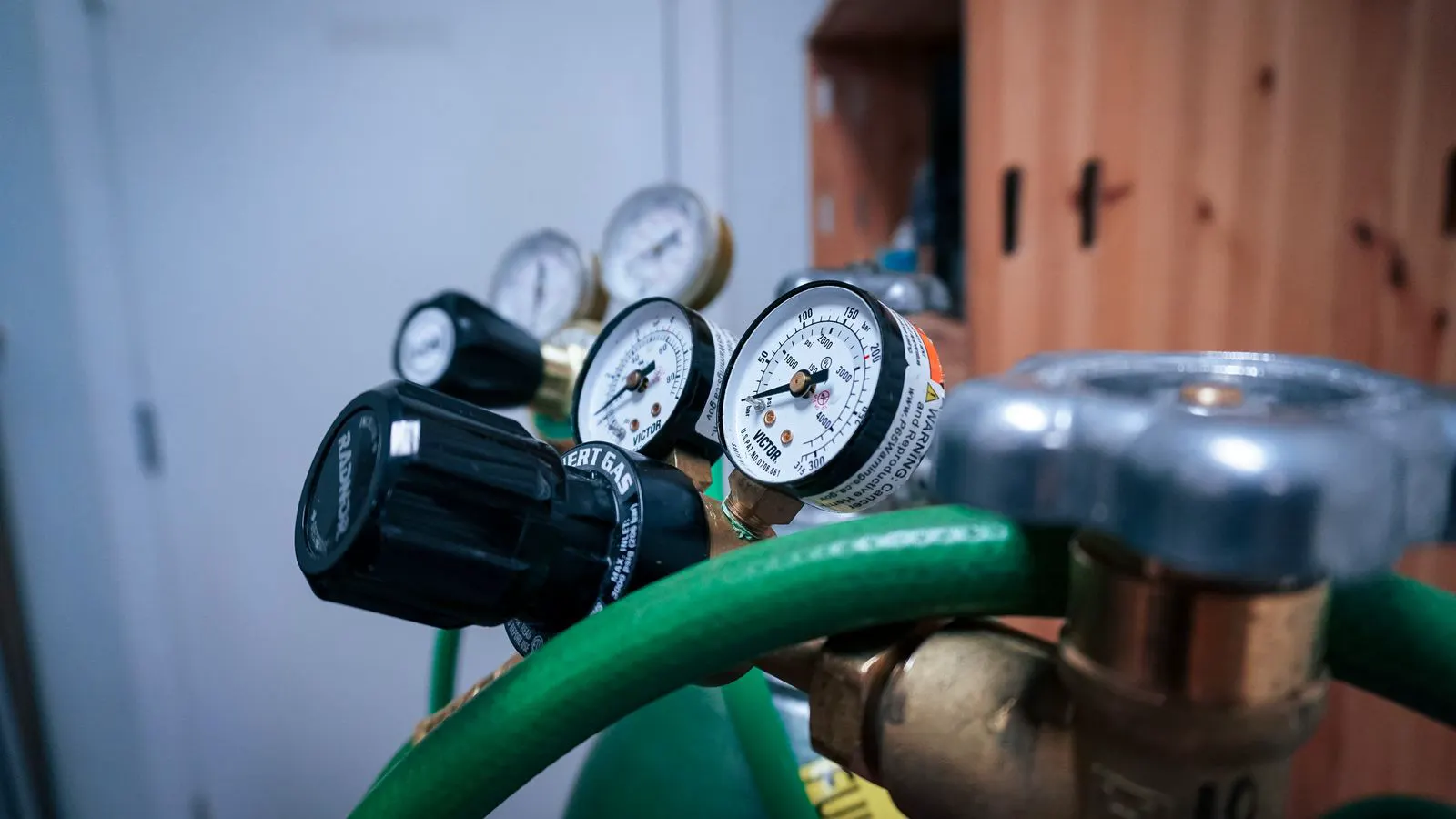
Check the flow rate with a flow meter. Do not rely on the gauge on the machine. A faulty gauge can send too little gas and cause porosity. Too much gas can cause turbulence and pull in air.
Check the nozzle condition. A damaged nozzle creates uneven gas flow. This is more critical with helium because the arc is hotter. A small leak can create a large defect.
Check the machine settings. Helium may require a different voltage or wire feed speed. Adjust the settings based on the test coupon, not on assumption.
Common mistakes in thick plate gas selection
One common mistake is choosing the gas based only on cylinder price. The flow rate and consumption rate matter more. A cheaper gas with a high flow rate can cost more per weld hour.
Another mistake is ignoring the joint geometry. A wide V-groove requires more gas coverage than a narrow groove. The same gas may work well in one joint and fail in another.
Welders often skip the back-side purge for thick plate. Without a clean back side, the weld can crack or become porous. The gas choice does not fix a missing purge.
Procurement teams sometimes buy the wrong cylinder size. Helium cylinders are smaller, so ordering too many small cylinders can tie up storage space. Argon cylinders are larger, so too many can fill a room. Plan the storage based on the actual size and usage rate.
Final selection guidance
For most heavy fabrication jobs, argon gas for welding is the default. It is cheaper, easier to handle, and gives a stable arc. It works well for plate thickness in the common range and for most joint types.
Helium shielding gas makes sense when the plate is very thick or the production speed is high. The higher heat input and faster travel speed can save labor time. The cost is higher, but the labor savings can outweigh it.
A hybrid mix offers a balance. It gives more penetration than pure argon at a lower cost than pure helium. This is a good option for carbon steel thick plate where the schedule is important.
The final decision should come from a test coupon and a cost calculation. Measure the gas used per weld hour. Measure the labor time per joint. Compare the two numbers. The gas that gives the best result per dollar wins.
Frequently asked questions
Which gas is cheaper for thick plate welding?
Argon is usually cheaper per cubic meter than helium. However, helium may require a higher flow rate, so the total cost per weld hour depends on the specific setup and plate thickness.
Can I use argon for very thick carbon steel plate?
Yes. Argon works well for thick carbon steel. It may require more passes than helium, but it provides a stable arc and good penetration for most heavy fabrication jobs.
Does helium require a different machine setup?
Yes. Helium may need different voltage, wire feed speed, and flow rate settings. Always test a coupon before switching on a production line.
Is helium better for stainless steel thick plate?
Argon is generally preferred for stainless steel because it gives a cleaner arc and less spatter. Helium can be used, but it is less common for stainless steel thick plate.
How do I calculate the real cost of the gas?
Measure the flow rate in cubic meters per hour. Multiply by the cost per cubic meter. Add the cost of the cylinder or refilling. Compare the total for the expected number of weld hours.